
Is Big Tech Robbing Your NYC Commute? (And Why Throo Is Shaking Up Uber and Lyft)
Posted on October 22nd, 2026
It was Tuesday, 5:30 in the afternoon, and my phone was about to be thrown into the traffic because the road was slick with rain. Five minutes earlier, the sky had opened and turned 8th Avenue into a splash zone. I took out the usual rideshare app to get home to Brooklyn; the trip had cost $22 the day before.
Today? $89.49.
I looked at the screen to make sure I hadn’t chosen an armoured helicopter or a horse-drawn carriage by mistake. No, it was just a regular Honda Accord. The algorithm had picked up three raindrops, a state of localized panic, and my battery at a vulnerable 12%, whereupon it set off the dynamic “desperation surge.”
I sent in the request purely out of survival instinct. I stood under the dripping scaffolding for ten minutes, shivering as the yellow cabs passed by. At that point, my phone gave a buzz: Driver Canceled.
Why? Because the app offered an exhausted driver $11 to drive through six blocks of Manhattan gridlock while the platform kept the other $78. They worked out the figures, decided to give up, and left. I couldn’t blame them at all.
When the next driver finally arrived, I got into the back seat, and we immediately began a daredevil race along the FDR Drive. He moved skilfully from lane to lane as if he were auditioning for The Fast and the Furious, his eyes rapidly switching from the flooded windscreen to three different smartphones fitted to the dashboard.
It was at that exact moment that I realized the entire rideshare system in New York City is completely broken.
Passengers are being overcharged. Drivers are being robbed. Safety is being neglected. And if you attempt to make a complaint, you’re sent into a digital black hole operated by an AI chatbot designed to make you doubt your own judgement until you stop complaining.
The 50% Heist Hiding in Plain Sight
We have all been led to believe that Uber and Lyft are merely “linking together riders and drivers” in return for a small technology fee, and corporate earnings statements refer to average take rates of 20% or 25%.
But if you ask any driver who works for these companies to look at their payout statement and compare it with your receipt, you’ll see how harsh the situation really is: on each individual trip, these apps take 50 percent or more of the amount you pay.
They achieve this by using a dodgy method known as decoupled upfront pricing. Rather than charging a fair amount for each mile and then paying the driver a fixed share, the algorithm uses two entirely separate formulas:
How much can we get from this desperate passenger at the present moment?
How low can we go with the crumb we give this driver so that they don’t log off?
When you pay $120 to get to JFK in the rain, the driver doesn’t receive that amount. Instead, they may get only a flat $5 “surge bonus,” and Big Tech takes the rest, more than $60, as a “platform fee.” You’ve been cheated. The driver is short-changed. And the algorithm wins a corporate promotion.
Behind the Wheel: Why Drivers Feel Trapped
The story I heard from drivers during my recent journeys around the city was always the same: they felt completely trapped in an economic dilemma.
A large number of these drivers are supporting families both here and overseas, working daily shifts of 12 to 14 hours while paying enormous amounts for vehicle leases, facing rising prices for commercial gasoline, and being obliged to pay mandatory TLC insurance fees.
If Uber and Lyft take 50% of the fare, drivers cannot afford to go on strike or walk off the job, because they have bills due the day after tomorrow and no financial safety net to rely on. They take on all the risk, pay all the overhead costs, and put in long hours, only to see a Silicon Valley algorithm take half of the money they have earned.
That is why the zero-commission model is more than just a smart feature of an app; it is a financial lifeline for these drivers.
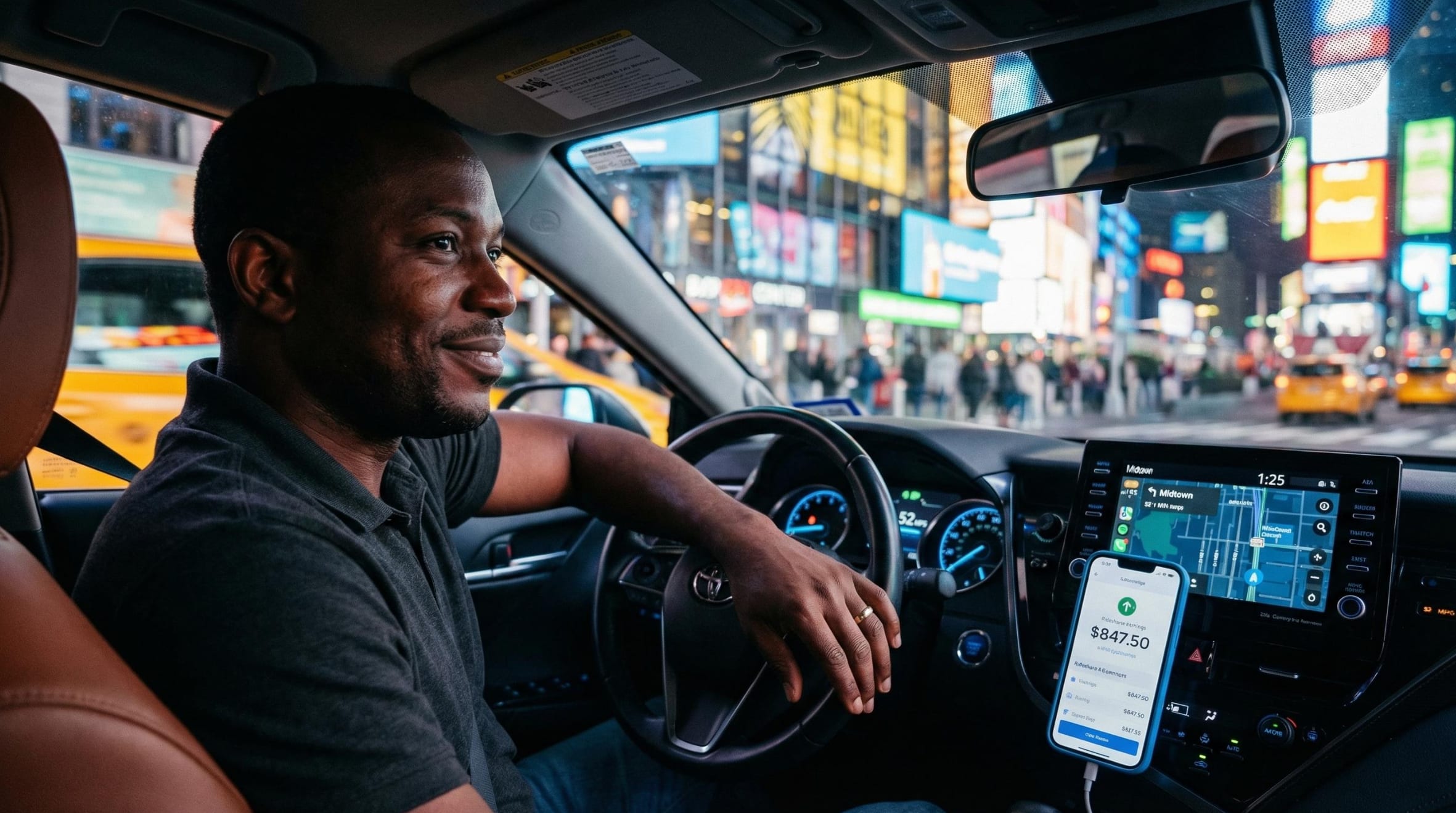
Incentivized Chaos: Why NYC Streets Feel Like a Video Game
What most people fail to notice is that algorithmic greed leads to reckless driving.
A driver who sees more than half of each fare disappear into thin air is forced to solve a frightening, high-stress math problem. To pay for the vehicle lease, fuel, TLC insurance, and city taxes, they can’t simply drive; they have to sprint.
The app actively pushes them to:
Treat yellow lights as challenges: since seconds mean survival, safe following distances are seen as unused real estate.
Run 12-hour marathons: putting up with harsh, exhausting shifts just to complete arbitrary “quests” on the app that make up for lost earnings.
Drive distracted: tapping their screens mid-turn to look for their next trip before the current one has even finished.
When an app makes a driver feel as though every red light is costing them money, driving turns into an adrenaline-fuelled race, and all the other road users end up paying the price.
The Lawsuit Hobby: Pay the Fine, Change Nothing
A business model this predatory should eventually come up against the law, shouldn’t it? In fact, it has.
At this stage, Uber and Lyft go beyond simply employing legal teams; they treat multi-million-dollar class-action lawsuits as if they were a software subscription fee.
From massive wage-theft settlements with the New York State Attorney General to endless legal battles with the NYC Taxi and Limousine Commission (TLC), Big Tech has always treated local regulators as minor speed bumps. Uber even took the TLC to court in an attempt to cancel the city’s cap on for-hire vehicles. After all, how could a city possibly be expected to protect driver earnings and prevent gridlock when there are shareholder dividends to boost?
The Big Tech Rideshare Cycle:
Use algorithm tricks to underpay drivers and overcharge riders.
Get sued by the Attorney General and the TLC for hundreds of millions.
Release a standard PR statement saying, “We promise to do better!”
Make no changes to the actual app.
Repeat next quarter.
If these companies invested even half the engineering effort into fixing their platforms that they spend on suing the TLC and funding legal defenses, public transportation in New York City would be a utopia. But why fix a broken system when you can pay the court and keep the algorithm running?
The Customer Support Black Hole vs. The Real-Human Experience
Before setting up my travel agency, I spent many years working on the front line of customer service. I know what good support looks like, and I can tell when a company is using its support service as a barrier to keep customers at a distance. Uber and Lyft have created a black hole specifically designed to wear down your mental strength until you eventually give in, through endless drop-down menus, useless AI bots, and automated emails signed by “Alex” offering a $2 credit as a remedy for a bad night.
When I heard about an app called Throo that offered real-time human phone support, I wasn’t convinced, so I decided to put it to the test. I picked up the phone, dialled their support line, and waited for the automated trap.
Instead, a man called Bobby answered.
Bobby not only listened but also did something that has long since disappeared from modern technology: he took the time to genuinely find out what the problem was. Uber and Lyft train their bots to give you a $5 credit to close the ticket and get you out of their way. Bobby didn’t try to bribe me into ending the conversation; instead, he took the time to investigate what had happened so his team could make sure it wouldn’t happen again to anyone else.
To be honest, Bobby could give Uber and Lyft’s support teams a masterclass in how to actually treat human beings. But let’s be realistic: Big Tech is far too cheap to employ real agents like Bobby when it can use a $0.02 AI script that simply ghosts you.
Enter Throo: The Zero-Commission Rebellion Taking Over NYC
You’re probably tired of being treated like a number in a spreadsheet. The good news is that the duopoly is finally facing real, disruptive competition in the five boroughs.
Throo is an independent mobility platform built on a radical idea: what if the app simply stopped interfering and let drivers keep the money they actually earn?
Backed globally by MVL, a company that has successfully handled more than 150 million rides in international markets, Throo didn’t come to New York City to follow Silicon Valley’s usual pattern of exploitation and extraction. Instead, it started out with a fully verified TLC licence (TLC Base Licence No. B03757) and a business model deliberately designed to erode the duopoly’s profit margins from the inside.
Throo is built on one crucial rule: it charges drivers no commission.
The Fare Breakdown (Example: Manhattan → JFK Airport)
Traditional Apps (50%+ Take Rate Trips):
Rider pays: $135+ (rain/demand surge active)
Platform takes: 50%+ commission plus hidden service fees
Driver keeps: $55–$65 (and covers tolls and gas out of this share)
Throo Zero-Commission Model:
Rider pays: ~$80 (transparent fare structure)
Platform takes: $0 commission (only a small fixed platform fee)
Driver keeps: 100% of the fare (after mandatory NYC taxes and TLC fees)
Rather than taking 25% to 50% of each fare from drivers, Throo works as a straightforward utility. Riders pay a fair upfront fare, Throo takes a small, fixed transaction fee to cover server costs and customer support, and the full amount of the actual fare goes directly to the driver.
The Throo Advantage: How the Zero-Commission Engine Works
Throo is more than just an app with a different logo; it represents a fundamental overhaul of how ride-hailing economics work. Here’s why this alternative is quickly gaining traction in New York City.
1. Why Drivers Are Switching to Throo
For NYC Taxi and Limousine Commission drivers, switching to Throo is a matter of simple arithmetic. With traditional apps, a driver might put in 12 grueling hours, complete [XX] trips, and spend $60 on fuel, only to end up with $180 after the platform takes its large commission.
On Throo, because drivers keep 100% of the fare:
They need far fewer trips to reach their daily financial targets.
Their cars suffer much less wear and tear.
They save hundreds of dollars each month on fuel and electricity.
They aren’t forced into grueling, hazardous 14-hour shifts just to cover their car leases and TLC insurance.
When drivers are paid the true value of each trip, driving becomes a sustainable profession rather than a financial emergency.
2. Why Riders Stop Getting Gouged
Because Throo doesn’t have to raise fares to meet the expectations of Wall Street investors demanding 50% profit margins, ride prices on the city’s main routes are consistently 30 to 40 percent lower, even during storms. This is especially true on high-volume journeys such as Downtown to JFK or LaGuardia, and cross-borough commutes between Brooklyn, Queens, and Manhattan.
The price you see on the screen before booking is exactly what you pay. There are no artificial “dynamic pricing spikes” just because your battery is low, a concert has ended, or the weather has turned grey.
3. Safer Roads Through Fair Pay
When drivers are paid fairly for their work, the urge to race through traffic disappears. With Uber and Lyft, a delayed pickup means lost earnings and missed bonus targets. With Throo, drivers aren’t forced to treat yellow lights as enemies or weave dangerously across lanes on the FDR Drive just to get by.
A well-paid driver stays calm and patient, putting passenger safety ahead of algorithmic speed. Throo also strictly enforces TLC fatigue limits and vehicle maintenance policies to make sure every car on the road is safe, compliant, and driven by a well-rested driver.
4. The End of “Ghost Pickups” and Sudden Cancellations
We’ve all been there: an Uber or Lyft driver accepts the ride, and then we’re left freezing six blocks away, waiting ten minutes while they hope we’ll cancel. This happens because the algorithm assigned them a low-paying trip that would actually cost them money once fuel and traffic are factored in.
On Throo, drivers keep the whole fare, so trips are actually worth taking. The result?
Nearby drivers accept rides right away.
Pickup times have improved across all five boroughs.
No more ghost pickups or sudden cancellations.
5. Powered by Proven Global Infrastructure (MVL)
Throo isn’t a startup that popped up out of nowhere in someone’s garage. It’s backed by MVL (Mass Vehicle Ledger), a well-established global mobility network that has already completed more than 150 million rides in Southeast Asia.
The MVL ecosystem focuses on fair-reward technology for drivers, transparent data management, and sustainable transport infrastructure. Bringing this technology to NYC gives New Yorkers a reliable, enterprise-class app backed by years of proven real-world performance.
The Side-by-Side Reality Check
Feature | Traditional Big Tech (Uber/Lyft) | Throo NYC Model |
|---|---|---|
Driver Commission Cut | Up to 50%+ on surge trips | 0% (driver keeps 100% of fare) |
Rider Pricing | Opaque “desperation” surge pricing | Upfront, flat, fair rates |
Customer Support | Automated bots and loop menus | Real human support (call Bobby!) |
Driver Payout Fairness | Decoupled algorithms / low base pay | Transparent 100% fare payout |
Pickup Reliability | High rate of cancellations and ghosting | Fast pickups, high acceptance rates |
TLC Regulatory Compliance | Fought the TLC in court / sued the city | Fully TLC licensed (B03757) |
Why Throo Belongs in NYC and Across All 50 States
I wouldn’t write any of this unless I truly meant it. There hasn’t been a real competitor to Uber and Lyft for a long time, and the rideshare market has suffered because of it.
I truly believe Throo should stay in New York City for good and eventually operate in all 50 states. They have the means, the technology, the international backing, and, most importantly, the right idea for making transportation fundamentally better. Riders should get cheaper fares, drivers should keep the money they earn, and everyone should get customer service that actually answers the phone.
Everyone should try Throo at least once; once you experience how much better a ride can be, you will never want to go back.
Share Your Travel Needs
Contact Us
Location
Bellmore, New York